
Marion County Projected Dates
A projected or scheduled date is an agency's current calculation. An actual release date records when the person left that custody. They are not interchangeable. Marion County Jail does not publish a verified online date calculator. A person awaiting trial may have no fixed date at all because bond, a judge's order, warrant clearance, or a hold from another agency can control the next move.
A sentenced GDC prisoner has a different record path. The calculation begins with the sentence, effective date, and credit for time already served. It can also reflect parole eligibility, Board action, program credit, misconduct, and limits imposed by the offense statute. A date shown now can move before release.
Choose Marion County's Date Source
The source follows the custody. A bond release from Marion County Jail belongs in the jail release entry and court docket. Sheriff Derrell Neal's office operates the county detention-center function. A transfer from that jail to GDC is a county-facility departure, not freedom from custody. Once a person becomes a state prisoner, GDC and the Parole Board become the main date sources. A federal case belongs in BOP records, not a Marion County or GDC search.
| Last known status | Best date source | Meaning |
|---|---|---|
| Pretrial at Marion County Jail | Jail and court | Bond or an order may change custody; no set date may exist. |
| Serving a county jail sentence | Jail record and sentencing court | Confirms sentence end, credit, or another court direction. |
| Transferred to state prison | GDC offender search | Shows the state custody stage and available release information. |
| Under parole review | Parole Board TPM lookup | Shows a tentative review month, not a final date. |
| Already released on parole | Parolee Database | Confirms post-prison supervision rather than final discharge. |
This separation prevents a common error. A person who posted bond after a short Marion County jail stay may never appear in GDC. Conversely, someone committed to state custody may no longer be at the county jail but may still be confined.
Run a Marion County Date Lookup
Start with the person's full name, date of birth if known, booking or case number, and last known agency. The GDC offender query supports state-prison research, while Marion County Jail and the court handle local custody and sentence documents. Name-only matches should be checked against age, identifying details, offense, and case context.
- Identify whether the person is in county jail, GDC custody, federal custody, or already on supervision.
- For Marion County Jail, call (229) 649-3841 and ask for the release entry or current basis for custody.
- Check the court docket for bond, sentence, dismissal, jail credit, amended order, or commitment to GDC.
- For a state prisoner, search GDC by name, ID, or case details and read the facility and release fields.
- If parole is involved, distinguish the TPM lookup from the database for people already released on parole.
- Confirm a decisive date with the jail, GDC Inmate Records, or court record that created it.
GDC says its Find an Offender tool can show charges, facility location, and release date. It also advises written verification through Inmate Records and Information at PO Box 1529, Forsyth, GA 31029. That written path is stronger when the exact computation or an official record matters.
The GDC release-date FAQ explains both the offender search and the correction route for time-computation concerns.
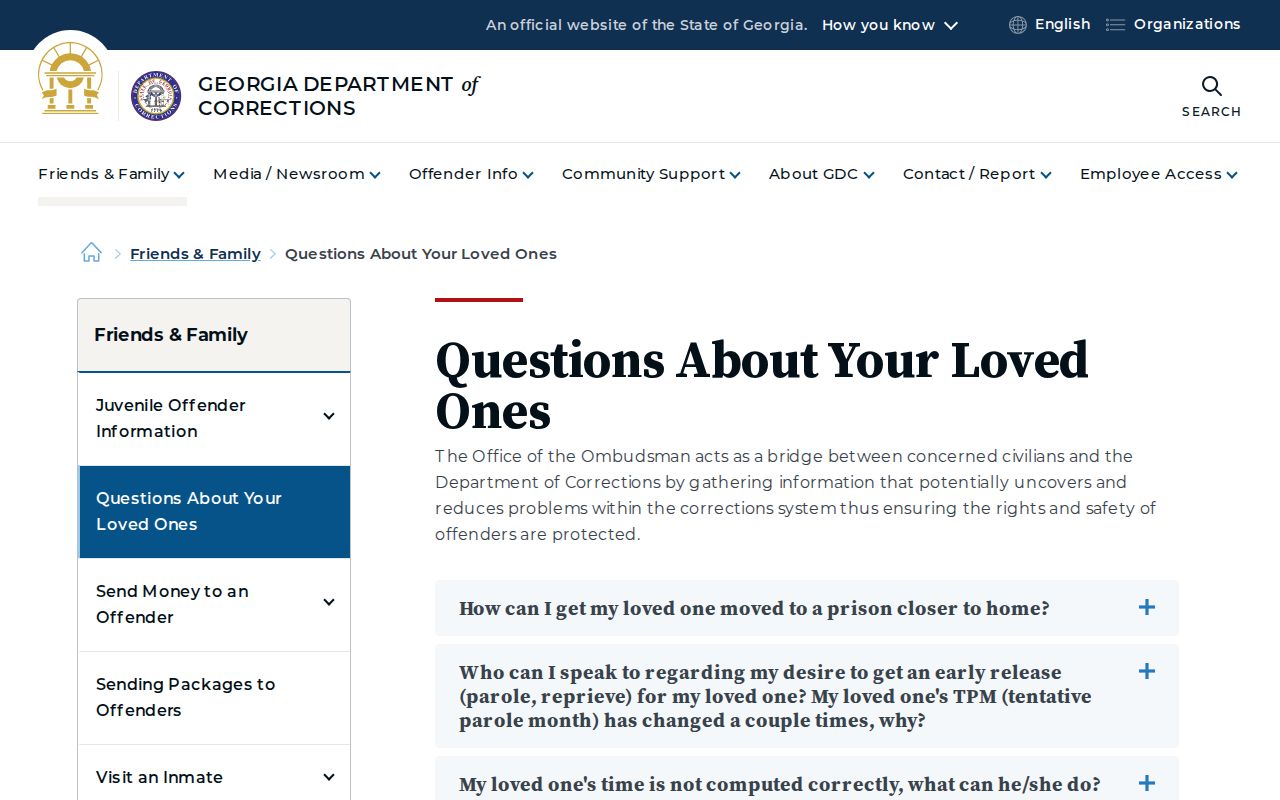
The GDC guidance shows why state records and county court documents may both be needed for one Marion County sentence.
Marion County TPM and MRD
Georgia uses several date terms. Maximum Release Date, or MRD, is the maximum date computed from the sentence after applicable credit and adjustments. A Tentative Parole Month, or TPM, belongs to the Parole Board process. The Board says a TPM is the month for final review and, if appropriate, the setting of a release date. It is not a final parole decision.
- Release date
- The date custody ends or is currently scheduled to end, as described by the source.
- MRD
- The maximum computed end point after sentence credit and lawful adjustments.
- TPM
- A tentative month for Parole Board final review, not a promise of release.
- Jail credit
- Time already served that the sentence record credits toward confinement.
- Detainer
- A hold or request from another authority that can prevent community release.
Misconduct or an unmet parole condition can postpone or cancel a TPM. Life-sentence cases may receive a grant or deny result rather than a TPM. For this reason, planning should be based on final Board action and current GDC status, not the tentative month alone.
The Georgia Parole Board TPM explanation sets out this distinction.
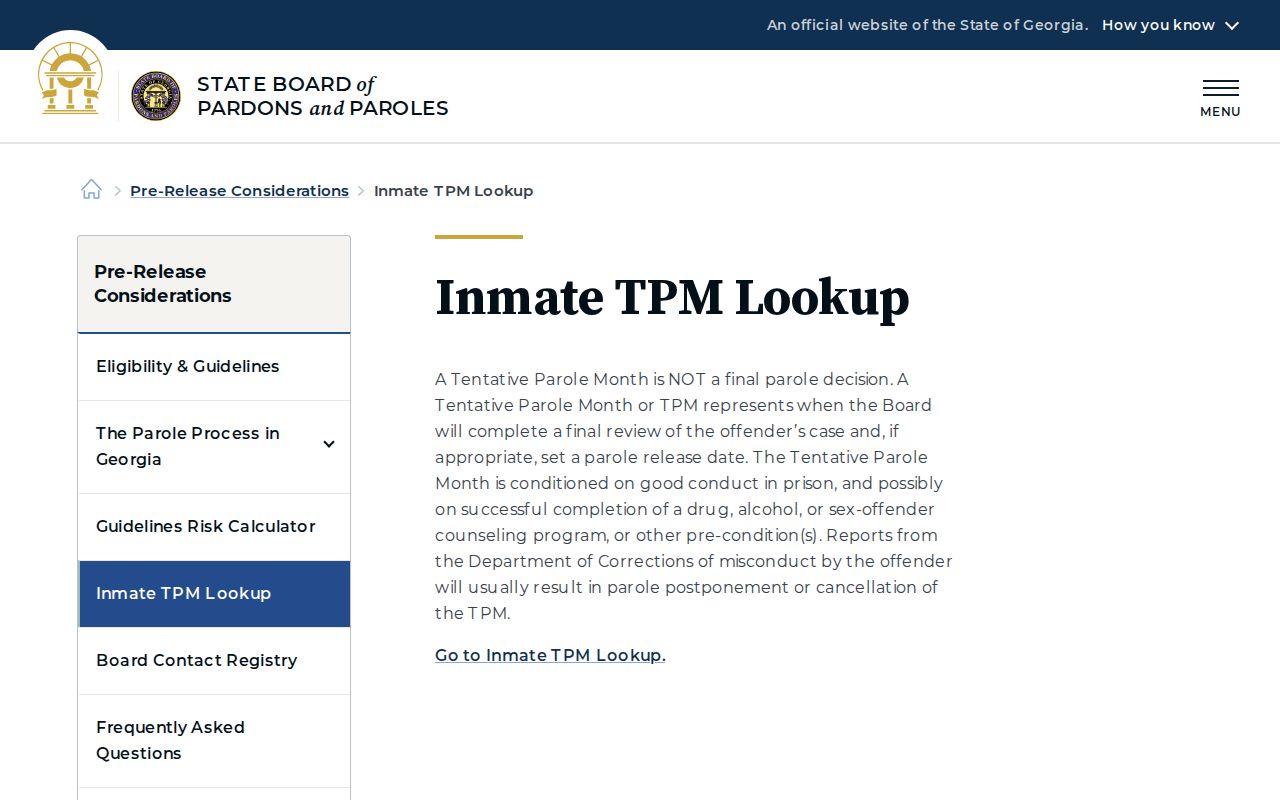
The Board's explanation is the key check against reading a TPM as a guaranteed Marion County release date.
Georgia Credits Affect Marion Dates
Georgia does not apply one fixed percentage to every projected release date. GDC's Performance Incentive Credit program, called PIC, can reward satisfactory progress in education, vocational work, treatment, work assignments, and conduct. Eligible prisoners can earn up to 12 points and may receive from 1 to 12 months off a TPM or MRD. PIC is not available to everyone.
Sentence length alone does not reveal the answer. The controlling offense, whether a mandatory term applies, the amount of valid jail credit, parole eligibility, and the person's program and conduct record can each matter. Two people with the same stated sentence can therefore have different projected paths. Only the responsible agencies can apply those facts to an individual computation.
GDC lists exclusions that include a death sentence, a sentence of two years or less, non-parole-eligible or minimum mandatory offenses such as covered serious violent felony cases, and life sentences. O.C.G.A. 17-10-6.1 restricts reductions for specified serious violent felonies. General parole eligibility under O.C.G.A. 42-9-45 also has offense and sentence exceptions. These rules are why a universal “85%” claim would be wrong for Georgia.
The GDC PIC program page shows the state framework for eligible reductions.
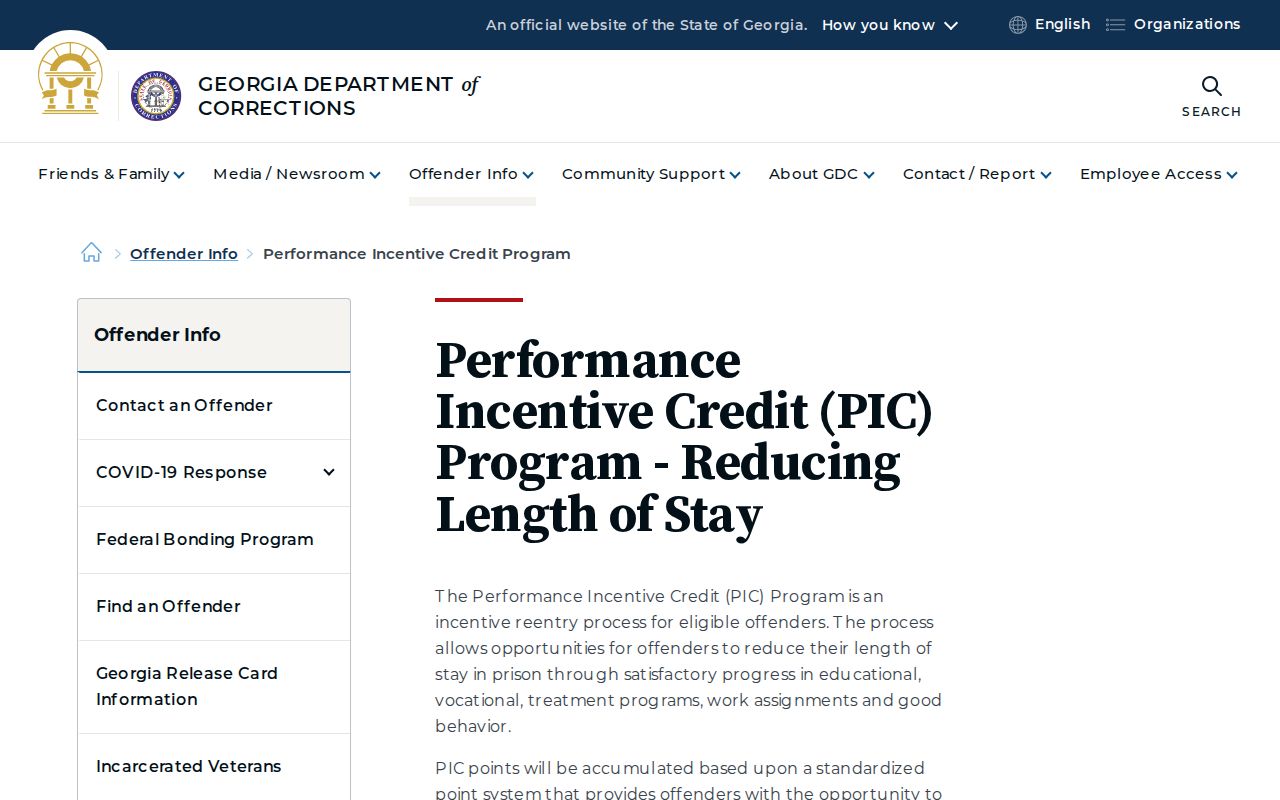
The program page separates earned reductions from the mandatory and sentence-based limits that can block them.
Note: Eligibility for parole review or PIC does not establish an actual release date; the latest agency decision and custody record control.
Why Marion Release Dates Move
A date can change for a favorable reason, an adverse reason, or a record correction. The effect depends on the sentence and authority involved. One factor may change the GDC calculation, while another changes only the parole path or prevents release to the community.
Dates can also appear to conflict when systems update at different points. Read the label, agency, and custody stage before deciding one date is wrong. A county jail transfer date, a GDC admission date, a TPM, an MRD, and an actual parole release can all belong to the same case without describing the same event.
| Factor | Possible effect |
|---|---|
| Corrected jail credit | Changes time already counted toward the sentence. |
| Amended sentence or court order | Changes the legal basis used in computation. |
| PIC progress | May reduce TPM or MRD for an eligible prisoner. |
| Misconduct | Can affect credit or postpone parole review. |
| Parole grant, denial, or condition | Changes the possible release path and timing. |
| Detainer or warrant | Can move the person to another custodian instead of the community. |
| Appeal, resentencing, or mismatch | Can require a new calculation or correction. |
A parole plan can also delay an otherwise possible release. Transfer logistics may affect the physical movement date. Each change should be tied to its source rather than inferred from an older screen capture or a prior projected date.
Correct Marion County Jail Credit
Georgia's local correction path is distinctive. GDC's family FAQ says a person who believes time was computed incorrectly should begin with the institutional counselor. A jail-credit issue may also require the clerk of court in the county of conviction. For a Marion County sentence, that means the state calculation may depend on a sentencing order or time-served record maintained at the county courthouse.
Compare four items: the sentencing order, the jail-credit record, the current GDC computation, and any Parole Board information. If the dates conflict, they may describe different stages. For example, departure from Marion County Jail on one day and entry into GDC custody on the next can be a transfer sequence, not two competing community release dates.
A narrow request is more useful than asking when someone “gets out.” Identify the case, ask what jail credit the court transmitted, and ask whether an amended order exists. GDC can then address how its computation reflects that record. Neither the county clerk nor the jail should be asked to predict a Parole Board decision.
Keep copies of the orders and written replies used in the review. If GDC changes a computation, compare the revised MRD or other date with the same source fields used before. If it does not change, the response may identify a statutory limit, missing court document, or another reason the requested credit was not applied.
Confirm Marion County Release
Final confirmation depends on the custodian. Marion County Jail can verify a local release or transfer entry. GDC can verify a state-prison release date and computation. The Parolee Database can show that a person left prison to parole supervision, while a court record can establish the sentence or order behind the change.
Georgia VINE can provide a pending custody-change alert, but it should not stand alone as the legal record. The Marion County VINE inmate check explains how to register and how to read the reporting agency. After an alert arrives, compare it with the jail, GDC, or court source.
If Marion County Jail says the person left for another county, GDC, the U.S. Marshals Service, or ICE, search the receiving system before calling the person fully released. “Released from the jail” and “released from custody” can describe different facts.
Once the date passes, look for an actual release entry rather than relying on the projection. Check the source again. If parole followed, verify supervision through the Parolee Database. If the person served the maximum term, ask whether GDC records show discharge. A final court or agency record closes the gap between an expected Marion County release and what occurred.